

Finding Your Way Back
Part Two of Two Read Part One Here
Finishing cancer treatment is supposed to feel like relief.
And in many ways it does. The relentless schedule of appointments, the anticipation of side
effects, the clinical intensity of the treatment period, all of that lifts. But what follows is not
always the return to normal that most survivors expected. The body that endured treatment is
not the same body that walked in before it began. And the road back to feeling like yourself,
truly like yourself, is its own journey, with its own timeline and its own demands.
This post is for everyone who has finished cancer treatment and is navigating what comes next.
Whether you have been a patient of 7 Stones through treatment or you are finding your way
here for the first time, there is meaningful support available for this phase of the journey that
most survivors are never offered.
What the Body Is Recovering From
Cancer treatment does not simply target cancer. It moves through every system of the body, and the systems that were healthy before treatment bear the weight of that process alongside the disease being treated. Chemotherapy and radiation deplete the immune system, disrupt digestion, damage peripheral nerves, exhaust energy reserves, and alter hormonal and neurological function in ways that can persist long after the last treatment session.
The research on this is clear and substantial.
Cancer-related fatigue is one of the most frequent symptoms experienced by cancer survivors, with research between 2013 and 2023 producing 21 systematic reviews and 12 meta-analyses examining its management. A 2023 Bayesian network meta-analysis and systematic review published in Frontiers in Oncology found that acupuncture may alleviate cancer-related fatigue by influencing neurological regulation, endocrine regulation, immune regulation, and rhythm regulation.
A 2023 randomized study found that acupuncture may help prevent chemotherapy-induced peripheral neuropathy, and a separate 2023 study found that acupuncture improves immunity and fatigue after chemotherapy in breast cancer patients.
A systematic literature review found that acupuncture has demonstrated efficacy in alleviating cancer-related fatigue, chemotherapy-induced peripheral neuropathy, and chemotherapy-induced nausea and vomiting.
This is the foundation of what post-treatment acupuncture care addresses. Not as a claim to treat cancer, but as documented support for the systems that cancer treatment depletes.
Sources: Tian H. et al., Frontiers in Oncology, 2023, doi:10.3389/fonc.2023.1071326; Huang MC et al., The Oncologist, 2023; Li J. et al., Supportive Care in Cancer, 2023; ScienceDirect systematic review, 2026.
Neuropathy: The Symptom Worth Treating Early
One of the most common and most treatable post-treatment conditions I see is chemotherapy-induced peripheral neuropathy. It typically begins in the balls of the feet and the tips of the fingers, presenting as tingling, numbness, or pain that can range from mildly uncomfortable to significantly limiting.
Many survivors are told this is simply something to manage. That it may improve over time on its own. And while that is sometimes true, acupuncture can be meaningfully effective in addressing neuropathy, particularly when treatment begins soon after symptoms appear rather than years later.
The longer neuropathy goes unaddressed, the longer the road to recovery tends to be. Partial recovery is still possible even in patients who have been managing neuropathy for years, but the outcomes are consistently stronger for those who seek support earlier. If you are experiencing neuropathy following cancer treatment and have been waiting to see if it resolves on its own, it is worth having a conversation sooner rather than later.
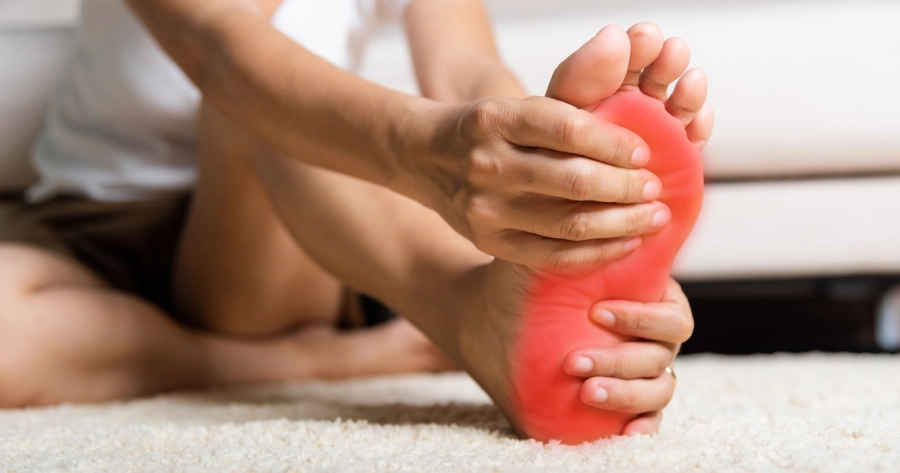
Person suffering from Neuropathy.
The digestive system is one of the first casualties of chemotherapy and one of the most important systems to restore in recovery. Loose stool, difficulty digesting food, reflux, and persistent low energy are among the most common complaints I hear from survivors coming in for the first time after completing treatment.
In Kototama Inochi Medicine, the spleen system governs digestion and the transformation of food into usable energy. When it is depleted, the body cannot extract adequate nourishment from even the most nutrient-dense foods. Restoring digestive function is foundational to everything else in post-treatment recovery, because a body that cannot properly digest cannot properly rebuild.
Treatment in this phase begins exactly where it always begins, with observation and pulse diagnosis, assessing where the person actually is before making any decisions about where to start. Often the digestive system and energy reserves are the first priority, because healing itself requires energy and a depleted system cannot participate meaningfully in its own recovery until it has enough resources to do so.
Reconnecting With Your Body
There is a dimension of post-treatment recovery that the clinical literature does not fully capture.
Many survivors describe feeling, in some way, betrayed by their body. The body they trusted and inhabited without thinking became the site of something frightening. Treatment asked them to surrender control of that body to medicine for months. And when treatment ends, the work of rebuilding trust with their own physical self is part of the recovery that rarely gets addressed.

Silohette of person opening arms with the sun behid her.
Acupuncture creates a space for that reconnection to happen. As the systems come back into balance, as energy returns and digestion stabilizes and the nervous system finds its way back toward regulation, people begin to inhabit their bodies again in a way that feels different from simply feeling better physically. They begin to feel present. To feel at home.
That is not a small thing after what they have been through.
Grace and Mirrors
One of the most important things I tell post-treatment patients is this: give yourself grace.
We live in a world and an environment that is far from a natural one. Cancers have likely always existed, but we now live surrounded by catalysts for cellular dysfunction that our grandparents never encountered. Environmental exposures, processed foods, chemical loads, chronic stress, these are not always things we chose knowingly or could have easily avoided. Finding yourself in the position of a cancer survivor does not mean you failed at something. It often means you lived in the world as it actually is.
At the same time, for some people a cancer diagnosis becomes one of the most clarifying experiences of their lives. It holds up a mirror and asks, honestly and without judgment: what are my priorities, and do my choices reflect them? That is not a comfortable question. But it is often the most important one available in the aftermath of something this significant.
Acupuncture can support both of these realities simultaneously. It helps the body recover. And it creates the conditions, as the nervous system settles and the physical noise quiets, for that deeper reflection to happen with more clarity and less reactivity than it could in the middle of treatment.
For Those Who Were Already in Care
For patients who were receiving acupuncture through treatment and are now transitioning into recovery, the work simply shifts in focus. Where treatment during the cancer period was oriented toward maintaining function, managing side effects, and keeping the immune system as supported as possible between treatment cycles, post-treatment care turns toward full systemic recovery. Restoring what was depleted. Rebuilding what was disrupted. And helping the body find its way back to a baseline that is not simply the absence of cancer but the presence of genuine vitality.
That distinction matters. The goal of post-treatment care is not to get you back to where you were before diagnosis. It is to help you arrive somewhere better, a body that is more aware, more balanced, and more capable of sustaining health than it was before this experience began.
Where to Begin
If you have completed cancer treatment and are navigating the recovery that follows, you do not need to wait until you feel ready or until things are bad enough to warrant seeking help.
Come in now. Come tell me where you are and what you are still carrying. We will assess where the system actually is and begin wherever the body is asking us to begin.
The hardest chapter is behind you. The work of coming back to yourself is worth every step it takes to get there.
7 Stones Acupuncture & Wellness serves patients throughout Sheboygan County and Southeast Wisconsin. To schedule an appointment or ask a question, call or text (262) 622-3602 or visit 7stonesacupuncture.com.
Sources: Tian H. et al., Acupuncture therapies for cancer-related fatigue: A Bayesian network meta-analysis and systematic review, Frontiers in Oncology, 2023, doi:10.3389/fonc.2023.1071326; Huang MC et al., Acupuncture may help to prevent chemotherapy-induced peripheral neuropathy, The Oncologist, 2023; Li J. et al., Acupuncture improves immunity and fatigue after chemotherapy in breast cancer patients, Supportive Care in Cancer, 2023; ScienceDirect, Neuroimmune mechanism of acupuncture in regulating cancer-related symptom clusters, 2026.

[…] Part Two Here […]