
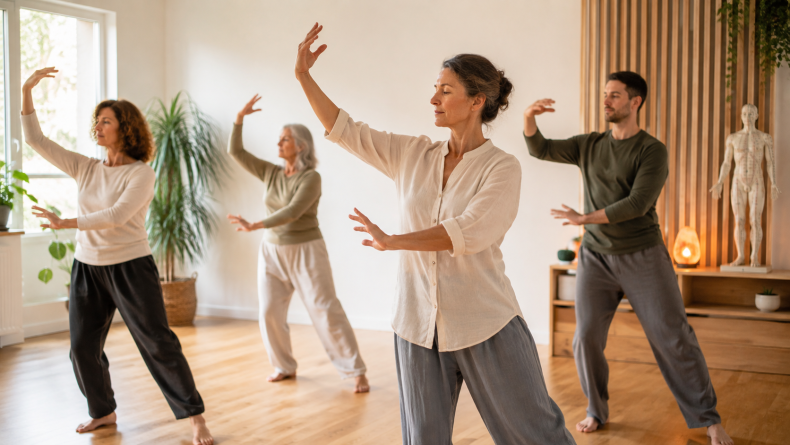
There is a practice that has been part of human civilization for over four thousand years. It requires no equipment. It can be done by virtually anyone regardless of age, fitness level, or physical condition. It has been studied extensively by modern Western researchers and shown to reduce stress, improve cardiovascular health, enhance immune function, support mental clarity, improve sleep, and increase overall vitality.
Most people in Southeast Wisconsin have never tried it. Many have never heard of it. That is about to change.
Beginning this month, 7 Stones Acupuncture and Wellness is proud to offer Qigong for Health and Vitality classes in our movement space, taught by Kettle Moraine Qigong instructor Ryan Gahagan. Classes meet Mondays at 6:30pm and Wednesdays at 10:30am. All experience levels are welcome. No experience is necessary.
What Is Qigong?
Qigong, pronounced chee-gong, is an ancient Chinese practice that combines intentional movement, breath work, mental focus, and observation to cultivate and balance the life force energy — the Qi — that flows through the body’s meridian system. Its roots stretch back to Daoist traditions dating to approximately 2146 BCE, where it was originally known as dao yin, meaning “guiding the Qi.” The Yellow Emperor, considered the originator of many Chinese health and longevity practices, recorded the foundational principles of these practices in a text called The Yellow Emperor’s Classic of Internal Medicine, which first appeared in writing around 300 BCE and is still considered a foundational text of Chinese medicine today. nihMeaningfulMoon
The term Qigong itself, which translates to “cultivating the Qi,” was popularized in the mid- twentieth century. But the practice it escribes is as old as Chinese civilization itself. At its core, Qigong works on the same foundational principle as acupuncture: the body contains a network of meridians through which vital energy flows, and when that flow is balanced and unobstructed, health and vitality naturally follow. Where acupuncture works on the meridian system from the outside through needle stimulation, Qigong teaches the practitioner to feel, cultivate, and guide that energy from within through movement and breath.
The Five Essential Elements
A complete Qigong practice integrates five elements working together as a unified whole.
Intent sets the purpose and direction of the practice. Where attention goes, energy follows. Beginning each session with clear intention focuses the mind and prepares the system to receive what the practice offers. Breath work provides the foundation. Deep, natural, conscious breathing nourishes the body, calms the nervous system, and serves as the bridge between the conscious mind and the body’s internal processes.
Observation cultivates awareness of body sensations, energy movement, thoughts, and emotional states without judgment or reaction. This is the quality of attention that transforms movement from exercise into medicine. Movement through gentle, flowing, intentional sequences opens the body, improves circulation, and enhances the flow of Qi through the meridians. Unlike vigorous exercise, Qigong movements are slow and deliberate, designed to work with the body’s natural rhythms rather than
against them. Integration brings all four elements together in a practice that harmonizes body, mind, and spirit
as a single living system.
What the Research Shows
Modern Western science has spent decades studying what Chinese civilization understood intuitively for millennia.
Qigong is now recommended for reducing the symptoms of anxiety and depression, improving breathing and coordination, managing pain, and alleviating fatigue. Research indicates that Qigong may help improve balance in individuals with Parkinson’s disease, reduce fibromyalgia pain, and enhance cardiovascular health. Additional studies suggest benefits for individuals with
chronic obstructive pulmonary disease, various cancers, and other ailments. Qigong has also been shown to improve cognition and memory, as well as aid in fall prevention, all of which are important benefits for aging adults. nih
A 2011 randomized controlled trial found Qigong to be comparable with cognitive behavioral therapy for reducing symptoms of clinical depression. A 2016 randomized controlled trial found that Qigong improved sleep duration, sleep efficiency, and mental health among cognitively impaired older adults who struggled with insomnia, and the positive impacts on sleep persisted
even four months after participants stopped practicing. Shaolin Temple These are not the results of a passing wellness trend. They are the documented outcomes of a practice refined over four thousand years.
Why Qigong and Acupuncture Belong Together
For patients of 7 Stones Acupuncture and Wellness, the addition of Qigong classes to our movement space is not an accident. It is a natural extension of the philosophy that has guided this practice since its founding. Kototama Inochi Medicine works to bring the organ systems into balance through observation and treatment of the meridian system. Qigong teaches the practitioner to feel and move the energy that flows through that same system. What acupuncture initiates from the outside, Qigong cultivates from within.
A regular Qigong practice creates a space where you are in a better position to take care of and manage your own health with less dependence on outside assistance over time. It elevates your own experience of what it is to be alive within a human body. And it creates a living connection between the treatment you receive on the table and the awareness you carry with you through
your daily life.
The two practices are not separate. They are two expressions of the same understanding.
Why Learning With a Teacher Matters
In an era of online videos and recorded classes for everything, it is worth understanding why Qigong is one practice where in-person instruction with a qualified teacher is not simply preferred but genuinely important.
Qigong Deviation Syndrome refers to the adverse reactions that may occur as a result of practicing Qigong incorrectly or without proper guidance. These reactions can be physical, energetic, and psychological. Qigong is like medicine — tremendously healing if prescribed correctly and used according to directions, but capable of negative side effects if practiced carelessly or without respect for its depth.
Physical symptoms of Qigong deviation can include dizziness, constricted breathing, tremors, localized pain, heaviness, insomnia, loss of memory, and sensations of excessive heat or cold. In rare and extreme cases, psychological symptoms including delusion have been documented. The most common causes of deviation include practicing without proper instruction, imitating Qigong seen in a video or online recording without understanding the underlying principles, and attempting to guide Qi internally without adequate preparation or guidance. This is not meant to frighten anyone away from Qigong — practiced correctly under qualified
guidance it is extraordinarily safe and beneficial for virtually everyone. It is meant to explain why showing up to a class with a skilled and experienced teacher is a fundamentally different experience from watching a recorded video at home and attempting to replicate the movements.
A teacher can see what a recording cannot. They can observe your posture, your breath, your energy, and your responses in real time and make corrections before small misalignments become problems. They carry the lineage of the practice in a way that no recording can transmit.
Meet Your Teacher: Ryan Gahagan
Ryan Gahagan brings to these classes a depth of experience that is rare in any wellness practice. A martial artist with over 35 years of training under a number of grandmasters, Ryan has spent those same 35 years studying Qigong of a Tibetan lineage under the same teacher in Portland, a commitment to a single lineage and a single teacher that reflects exactly the kind of long-term dedicated study that produces genuine mastery. His teacher has now tasked him with taking his studies out into the world and sharing them with those who are seeking to learn. Ryan is also currently enrolled in a graduate program studying Traditional Chinese Medicine through acupuncture and traditional Chinese herbs — bringing both the depth of his practical
experience and the rigor of formal academic study to every class he teaches.
He brings these classes to 7 Stones not as an outsider but as a practitioner whose philosophy and lineage align naturally with the work being done here.
Join Us
Classes meet Mondays at 6:30pm and Wednesdays at 10:30am at 7 Stones Acupuncture and Wellness, N3211 County Road S, Cascade, Wisconsin. $15 per class or four classes for $50. All experience levels welcome. Wear comfortable clothing. No experience necessary. To register or for more information, contact Ryan Gahagan at (920) 918-7204 or [email protected].
7 Stones Acupuncture & Wellness | N3211 County Road S | Cascade, WI 53011 | (262) 622-3602 | 7stonesacupuncture.com
Sources: Britannica, Qigong entry; Forks Over Knives, Qigong for Beginners; Somatic Sleep Coach, When Qi Goes Wrong; Long White Cloud Qigong, How Dangerous Is Qigong; PubMed/NIH, Dao Yin: Origin, Development, Potential Mechanisms and Clinical Applications.
